
How to check your breasts, and what to do if you notice a change

To check your breasts, look at them in a mirror, feel every part of each breast up to your collarbone and into your armpit, and contact your GP practice about anything that’s new or different for you. It takes a few minutes, once a month. The aim is to learn what’s normal for you, so that a change stands out.
Reviewed by Dr Rumaanah Ghantiwala, Beat Breast Cancer trustee, on 28 September 2026.
This guide is for everyone. Everyone has breast tissue, and men can get breast cancer too, so if you’d call it your chest rather than your breasts, the same steps apply.
It follows NHS advice. It’s general information, not medical advice, so if you’ve already noticed a change, contact your GP practice today rather than reading on.
How to check your breasts in three steps
You don’t need a special technique or any training to do a breast self-examination. NHS guidance comes down to this:
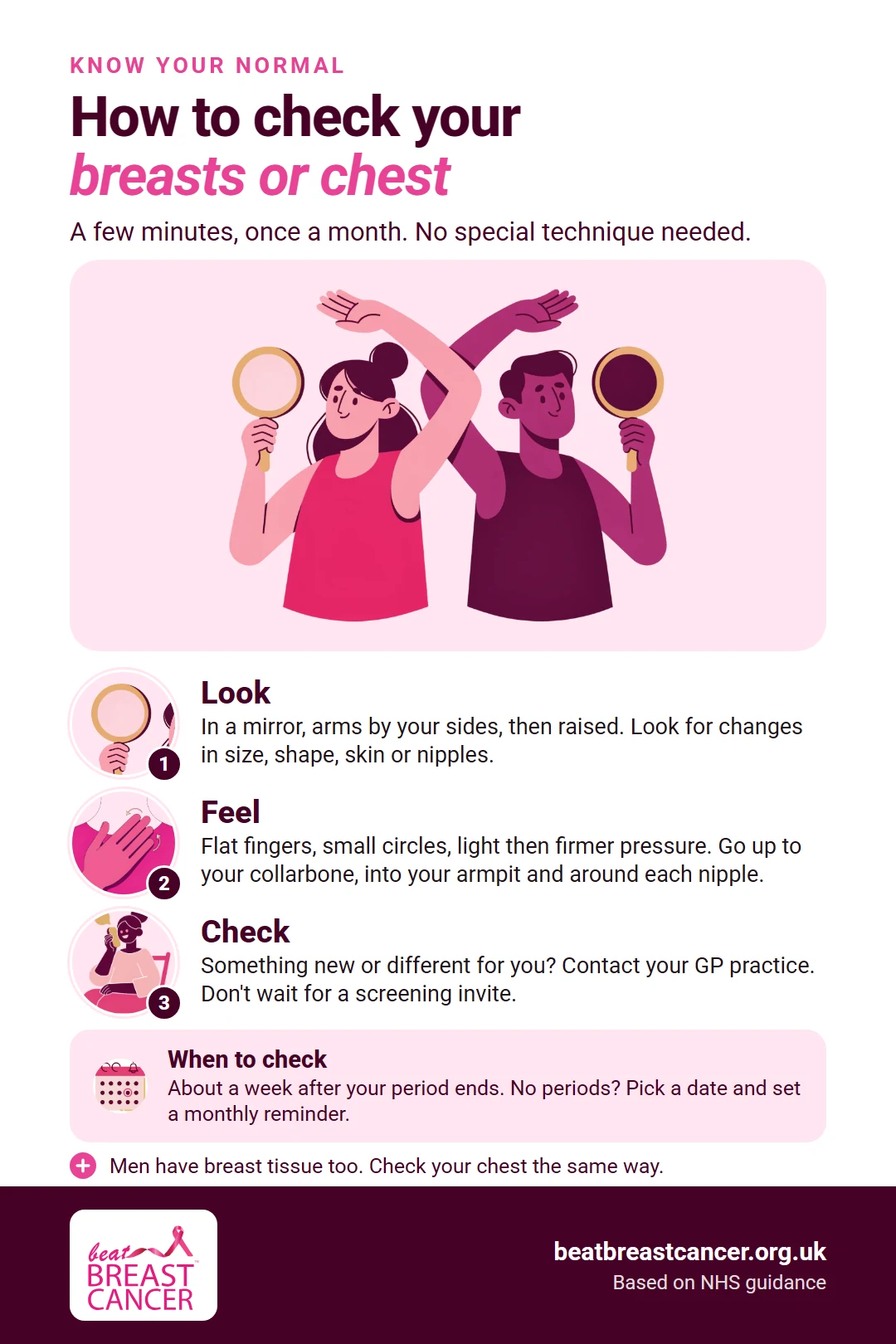
- Look. Stand in front of a mirror with your arms by your sides, then raise them above your head. Look for any change in the size or shape of each breast, in the skin, or in your nipples.
- Feel. Using the flat of your fingers, feel around each breast in small circles, all the way up to your collarbone and into each armpit. Use light pressure and then firmer pressure, but never so hard that it hurts. Finish by feeling around and over each nipple.
- Check. If something is new or different for you, contact your GP practice. Don’t wait for a screening invitation.
Where and when in your day
Wherever you’ll actually do it. The NHS says many people find it easier to feel their breasts in the shower or lying down, and Breast Cancer Now suggests in bed, in the shower or while getting dressed. Doing it at the same point in your routine each month is what turns it into a habit.
What normal feels like
There’s no single normal. It’s common for breasts to be different sizes, and the NHS points out that they naturally look and feel different at different points in your menstrual cycle, during pregnancy and breastfeeding, and after the menopause.
Many people’s breasts feel lumpy. Cancer Research UK lists normal lumpiness among the most common causes of harmless breast lumps, and says it’s usually more obvious just before a period. That’s why the first few checks are about getting to know your own pattern. After a few months you’ll know what’s usual for you, and that’s what you’re checking against.
If you’re trans or non-binary, or have implants
Check whatever breast or chest tissue you have, in the same way. After top surgery or breast implants, Breast Cancer Now advises getting to know your new normal once you’ve healed, then checking the whole area up to your collarbone and into your armpits. Top surgery removes most breast tissue, but some may be left, so the check still matters. If gender dysphoria makes checking hard, Breast Cancer Now suggests it may be easier to check under a top or without a mirror.
How often should you check your breasts?
Once a month. If you have periods, the best time is about a week after your period ends (NHS Essex guidance). If you don’t have periods, because of the menopause, contraception or anything else, pick a date and stick to it every month.
A reminder is what makes this stick. Set a repeating one on your phone now, or add a monthly reminder to your calendar and move it to the day that suits you.
Warning signs to look out for
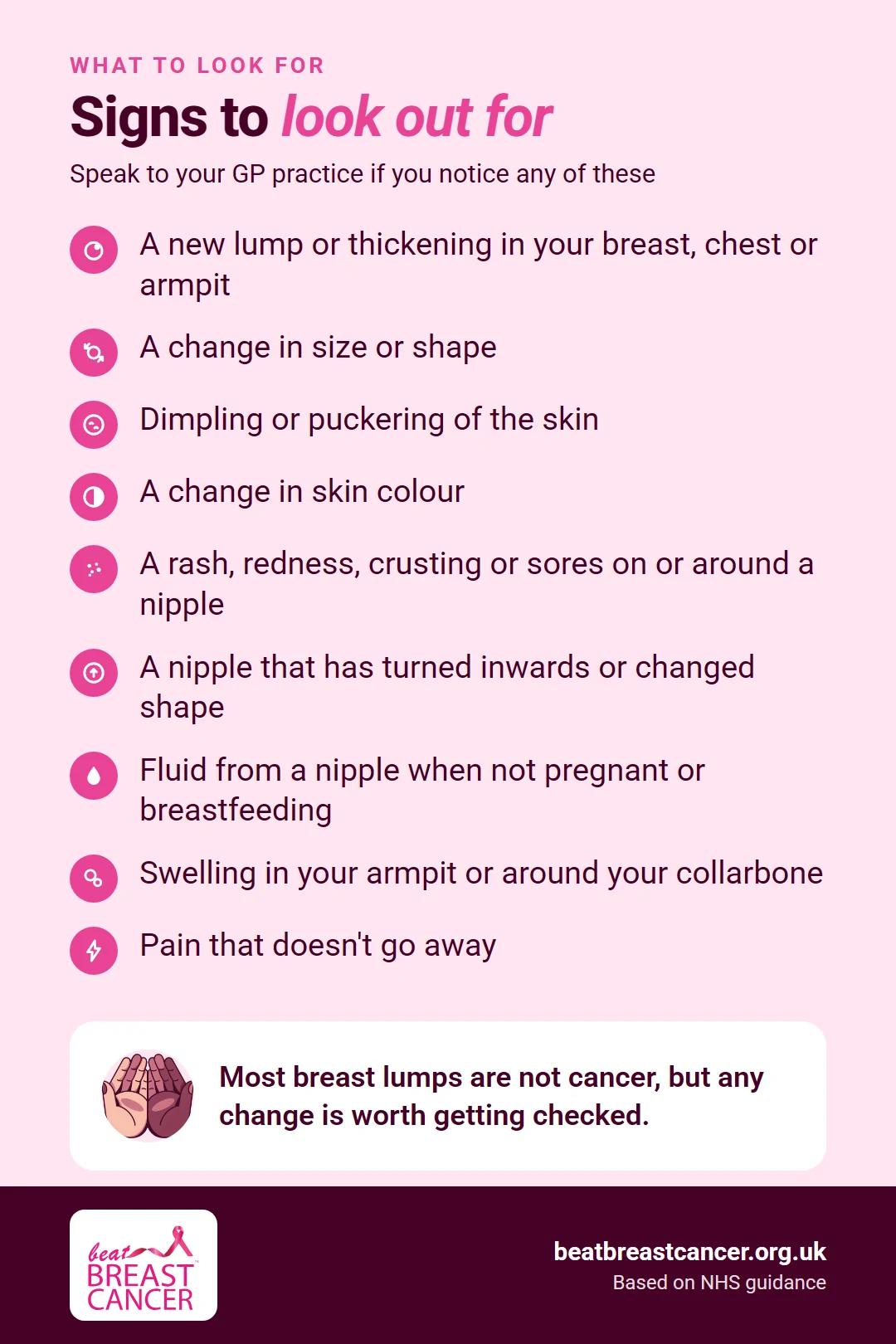
The main warning signs of breast cancer are a new lump or thickening in your breast, chest or armpit, a change in the size or shape of a breast, and changes to the skin or nipple. Speak to your GP practice if you notice any of these (NHS, Cancer Research UK):
- a new lump or thickening in your breast, chest or armpit
- a change in the size or shape of a breast, or of one side of your chest
- dimpling or puckering of the skin, sometimes described as looking like orange peel
- a change in skin colour
- a rash, redness, crusting or sores on or around a nipple
- a nipple that has turned inwards or changed shape
- fluid coming from a nipple when you’re not pregnant or breastfeeding, which may have blood in it
- swelling in your armpit or around your collarbone
- pain in your breast or armpit that doesn’t go away
Skin changes can be harder to spot on black or brown skin. The NHS explains that a change that looks red on white skin may look darker than usual on black or brown skin, so look for any change in colour, not just redness.
Breast pain on its own is common and isn’t usually a sign of cancer, according to both the NHS and Cancer Research UK. Pain that doesn’t go away, or feels unusual for you, is still worth getting checked, and the NHS says to see a GP about breast or armpit pain if breast or ovarian cancer runs in your family. For the wider picture on risk factors and what breast cancer is, see our page about breast cancer.
What does a breast lump feel like?
There’s no single way a breast lump feels, and you can’t tell what a lump is by touch. Harmless lumps can be hard or soft, smooth, painless or tender, and some move easily under the skin. The NHS says not to try to self-diagnose the cause of a lump. Get any new lump or thickening checked by your GP, however it feels.
Breast Cancer Now describes a fibroadenoma, one of the most common harmless lumps, as usually smooth, painless and easy to move under the skin, though it can feel tender just before a period. A breast cyst may be soft or hard. Even when a GP thinks a lump feels like a cyst, they’re still likely to refer you to a breast clinic to be sure. And a lump that doesn’t hurt still needs checking. The NHS points out that you can have the signs of breast cancer without any pain.
What happens if you notice a change
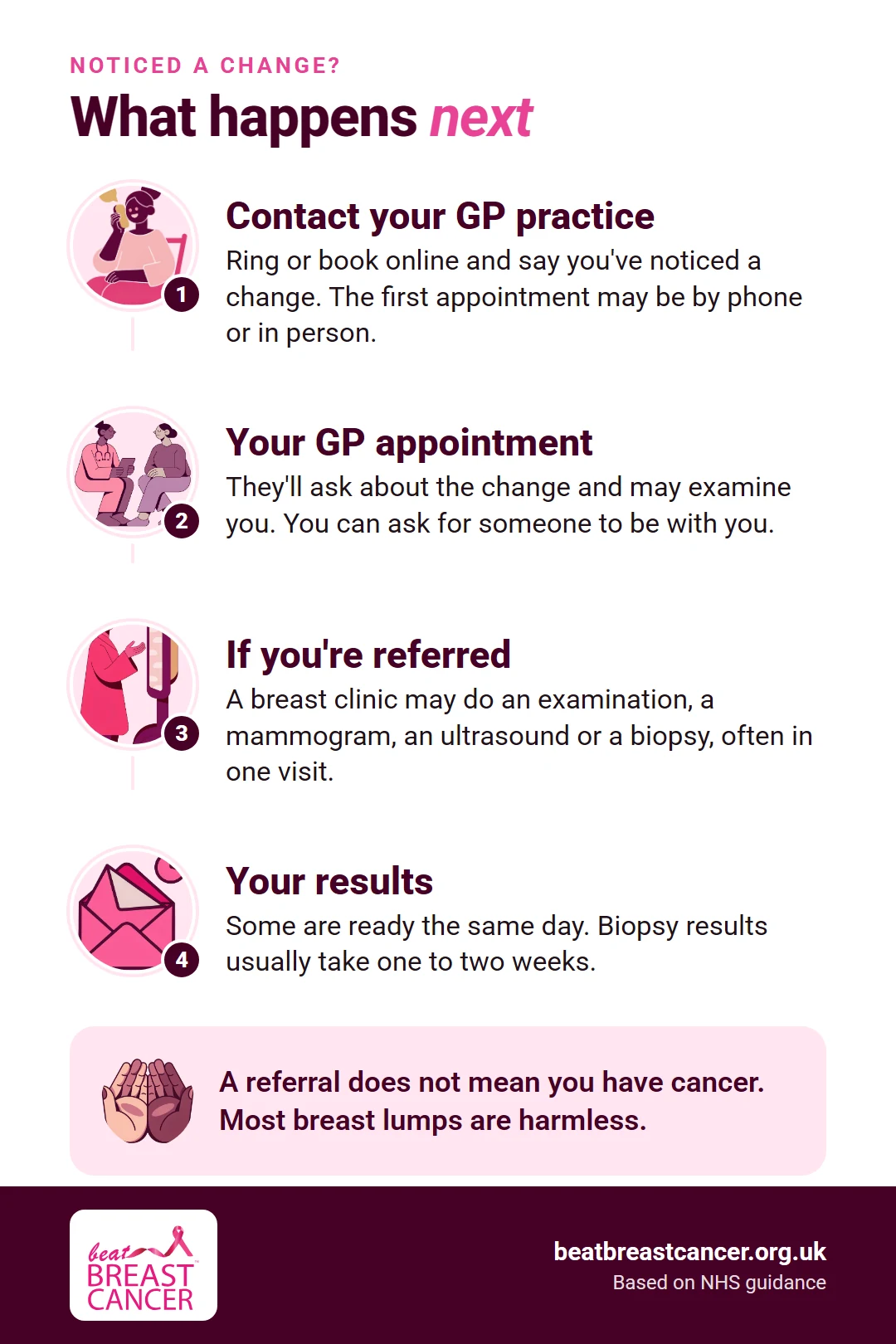
Contact your GP practice. The GP will ask about the change and usually examine you, then decide nothing more is needed, ask to see you again after a short time, or refer you to a breast clinic for tests. Most people seen at a breast clinic don’t have breast cancer (Breast Cancer Now).
Contacting your GP practice
Ring or book online and say you’ve noticed a change in your breast (or chest) and would like it checked. That’s all you need to say. Your first appointment may be on the phone or in person (Breast Cancer Now).
At the GP appointment
The GP will ask about the change, whether you’ve had breast screening before, and whether anyone in your family has had breast cancer. If you have a lump or another change, they’ll usually want to examine you. This is called a clinical breast examination, where a doctor or nurse checks your breasts and under your arms. You undress from the waist up behind a screen, and you can ask for a friend, relative or another member of staff to be in the room with you (NHS).
If the GP refers you, that does not mean you have cancer. It means the change needs a proper look by a specialist.
At the breast clinic
At the clinic you may have (NHS):
- an examination of your breasts
- a mammogram (a breast X-ray)
- an ultrasound scan
- a biopsy, where a small sample of cells is taken, usually with a needle
You may not need every test, and you’ll usually have the ones you do need in a single visit. Some results are ready the same day. Biopsy results usually take one to two weeks.
Most lumps are not cancer
The NHS says most breast lumps are harmless and that tests usually show a lump is not cancer. Cancer Research UK lists the most common harmless causes as normal lumpiness, cysts (small sacs of fluid) and fibroadenomas (a lump of fibrous, glandular tissue, more common in women under 40).
That is no reason to wait and see. If it is breast cancer, finding it early may make it easier to treat, and the only way to know is to get it checked.
If the waiting is hard, you don’t have to sit with it alone. Macmillan Cancer Support runs a free helpline every day from 8am to 8pm on 0808 808 00 00.
NHS breast screening, and why you still need to check
Checking yourself and NHS screening do different jobs, and you need both.
NHS breast screening is offered to everyone registered with a GP as female, from age 50 up to their 71st birthday. Your first invitation arrives between your 50th and 53rd birthday, then every three years after that. You need to be registered with a GP surgery to be invited.
- Not been invited by 53? Contact your local breast screening service.
- 71 or over? Invitations stop, but you can still have screening every three years. Ring your local breast screening service to book.
- Trans or non-binary? How you’re invited depends on the sex you’re registered as at your GP surgery. The NHS page linked above explains the options, or ask your GP surgery.
At the appointment, each breast is squeezed between two plastic plates for a few seconds while the X-ray is taken. The whole appointment takes no longer than 30 minutes, and you’ll usually get your results within two weeks (NHS).
Screening can find cancers when they’re too small to see or feel (Cancer Research UK). It only happens every three years, though, and a small number of breast cancers develop in the gap between appointments (Hull University Teaching Hospitals NHS Trust). So keep checking every month. If you notice a change, the NHS is clear that you should see a GP and not wait for your next screening, even if you had one recently.
If you’re invited, please go. Our breast cancer statistics post shows how many women take up the invitation and what screening finds each year.
Checking your chest if you’re a man
Breast cancer in men is rare, but around 420 men are diagnosed with it in the UK every year (Cancer Research UK). Men have breast tissue around the nipple, and it can be affected in the same way.
Check your chest with the same three steps: look in the mirror, feel the whole area up to your collarbone and into your armpits, and get any change looked at. The NHS lists five signs to look for in men:
- a lump or swelling in your chest or armpit
- fluid leaking from a nipple, which may have blood in it
- a change in the size or shape of either side of your chest
- sores or ulcers on your chest
- a nipple that turns inwards, changes shape or has a rash on it
Cancer Research UK notes that in men the lump is nearly always painless. A painless lump still needs a GP appointment. Our breast cancer statistics post has the fuller UK figures for men.
Who we are, and why we care about early diagnosis
We’re Beat Breast Cancer, a family-run UK charity with a 100% donation policy. There are no wages and no admin costs taken out. Every penny funds equipment and research for NHS breast units.
In April 2023, for example, we gave £10,000 to The Christie in Manchester for specialist equipment to help diagnose breast cancer earlier and more accurately. You can see every hospital we’ve funded on our donations page. Earlier diagnosis is what monthly checking is for too, and it’s why we wrote this guide.
Every October is Breast Cancer Awareness Month, and our awareness month post has more ways to get involved.

Keep this guide to hand
Bookmark this page and set a monthly reminder, so next month’s check doesn’t depend on your memory.
Set a monthly reminder
Put a repeating reminder on your phone for the same day each month, or add ours to your calendar and move it to the day that suits you. If you have periods, about a week after your period ends is best.
Help us fund NHS breast units
We’re a family-run charity with a 100% donation policy, so everything you give goes to NHS breast units. You can help with money, or with the bras and clothes you no longer wear.
Common questions about checking your breasts
How often should I check my breasts?
Once a month. If you have periods, check about a week after your period ends. If you don’t, choose the same date each month and set a reminder.
Should I check standing up or lying down?
Both work. Look in a mirror standing up, first with your arms by your sides and then raised. Many people find it easier to feel their breasts lying down or in the shower, so do the feeling part wherever you’re most comfortable.
What if my breasts always feel lumpy?
That’s common and usually normal. Breasts often feel lumpy, especially just before a period. What you’re looking for is a change from your usual pattern, such as a lump or thickening that feels different from the rest of your breast. If you’re unsure, ask your GP.
What age should I start checking my breasts?
There’s no set starting age. Anyone can get breast cancer, and around 2,300 women under 40 are diagnosed in the UK each year, according to Breast Cancer Now. Getting to know your breasts as an adult, well before screening starts at 50, gives you a normal to compare against.
Can men get breast cancer?
Yes. It’s rare, but around 420 men are diagnosed in the UK each year. Men should check their chest in the same way and see a GP about any lump, nipple change or swelling.
Are mammograms every three years enough?
Not on their own. NHS screening every three years can find cancers too small to see or feel, but a small number of breast cancers develop between appointments. Keep checking every month, and if you notice a change, see your GP rather than waiting for your next screening, even if you had a mammogram recently.
Can you have breast cancer and feel fine?
Yes. Breast cancer doesn’t always make you feel unwell, and screening can find it before there are any signs or symptoms. Cancer Research UK says to get symptoms checked even if you feel well, so go by what you see and feel in your breasts, not by how you feel in yourself.
Does finding a lump mean I have cancer?
No. Most breast lumps are not cancer, and are more often normal lumpiness, a cyst or a fibroadenoma. Always get a new lump checked by your GP, because only tests can tell you for certain.
Should I still check if I’m pregnant or breastfeeding?
Yes. Your breasts change a lot during pregnancy and breastfeeding, which makes it harder to know what’s normal, so keep checking and mention anything new or unusual to your GP or midwife.
Sources: NHS, How to check your breasts or chest; NHS, Symptoms of breast cancer in women; NHS, Symptoms of breast cancer in men; NHS, Breast lumps; NHS, Tests and next steps; NHS, Who breast screening is for; NHS, What happens at your breast screening appointment; NHS Essex; Hull University Teaching Hospitals NHS Trust; University Hospital Southampton NHS Foundation Trust, Your first breast clinic visit; Cancer Research UK, Symptoms of breast cancer; Cancer Research UK, Breast cancer in men; Breast Cancer Now, Touch Look Check; Breast Cancer Now, Transgender and gender-diverse people and breast cancer; Breast Cancer Now, Fibroadenoma; Breast Cancer Now, Breast cysts; Breast Cancer Now, What happens at a breast clinic appointment.
Last reviewed 28 September 2026 by Dr Rumaanah Ghantiwala, Beat Breast Cancer trustee, against current NHS guidance. Next review due September 2027.