
Gift Aid Explained: How to Make Your Donation Worth 25% More

If you’re a UK taxpayer, Gift Aid means we can claim an extra 25p from HMRC for every £1 you give us, at no extra cost to you as long as you’ve paid enough tax to cover it. Tick one box when you donate and a £20 gift becomes £25, without you paying a penny more.
It sounds almost too simple to be true, which is probably why so many donors skip it. It isn’t a catch, a fee, or a scheme you need to understand tax law to use. It’s a government initiative designed specifically to make your generosity go further, and for a charity like ours that passes on every donated penny, it’s one of the easiest ways to increase your impact.
How Gift Aid actually works
Gift Aid exists because the money you donate has already had tax taken off it before it reached your pocket. The scheme lets charities reclaim that basic-rate tax from HMRC, on your behalf, as long as you’re a taxpayer and you’ve said yes.
Here’s the maths in practice:
| You donate | Basic-rate tax we reclaim | Your gift becomes |
|---|---|---|
| £20 | £5 | £25 |
| £50 | £12.50 | £62.50 |
| £100 | £25 | £125 |
That’s a flat 25% uplift on every eligible donation, funded by HMRC, not by you. You don’t send us any more money. You just tell us we can ask for it.
Is Gift Aid 20% or 25%?
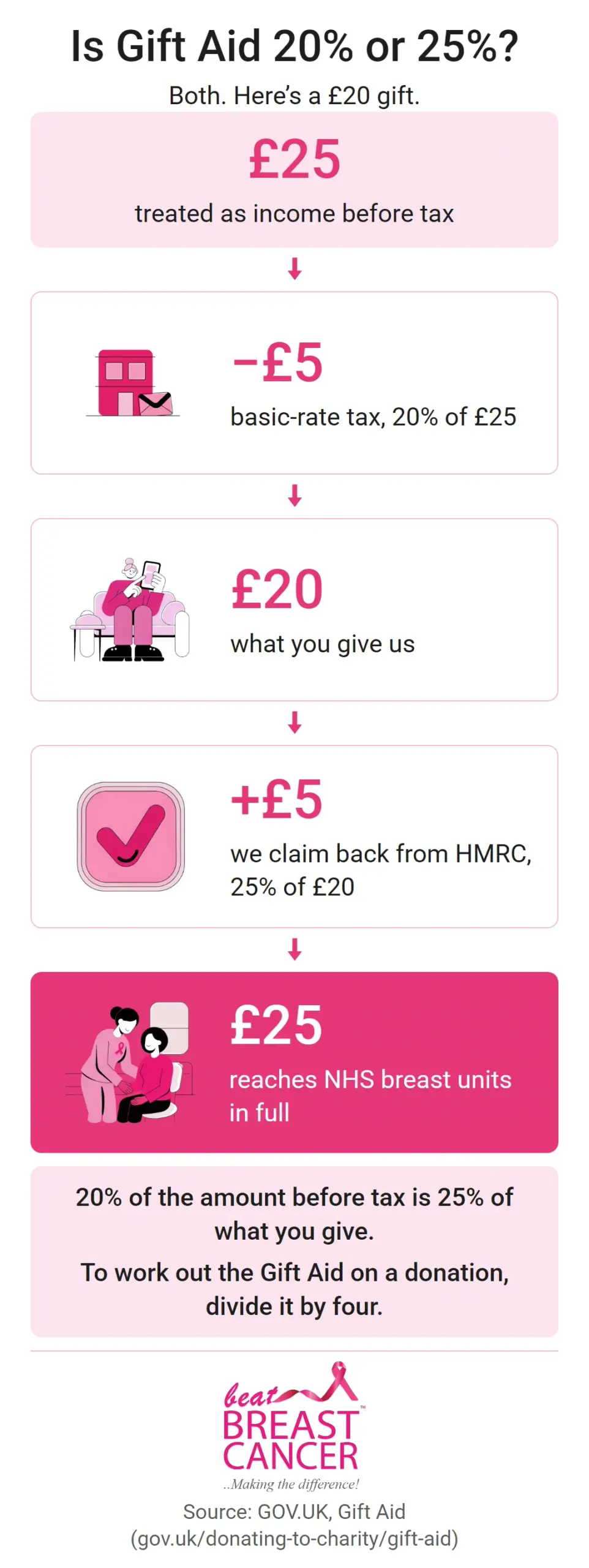
Both, which is why it catches people out. Basic-rate Income Tax is 20%, but it’s 20% of the amount before tax. For Gift Aid, a £20 donation is treated as what’s left of £25 once 20% basic-rate tax (£5) has been taken off, so when we claim that £5 back, your gift goes back up to £25. Measured against what you actually give, that’s 25% more. To work out the Gift Aid on any donation, divide it by four.
Why it matters more here than almost anywhere else
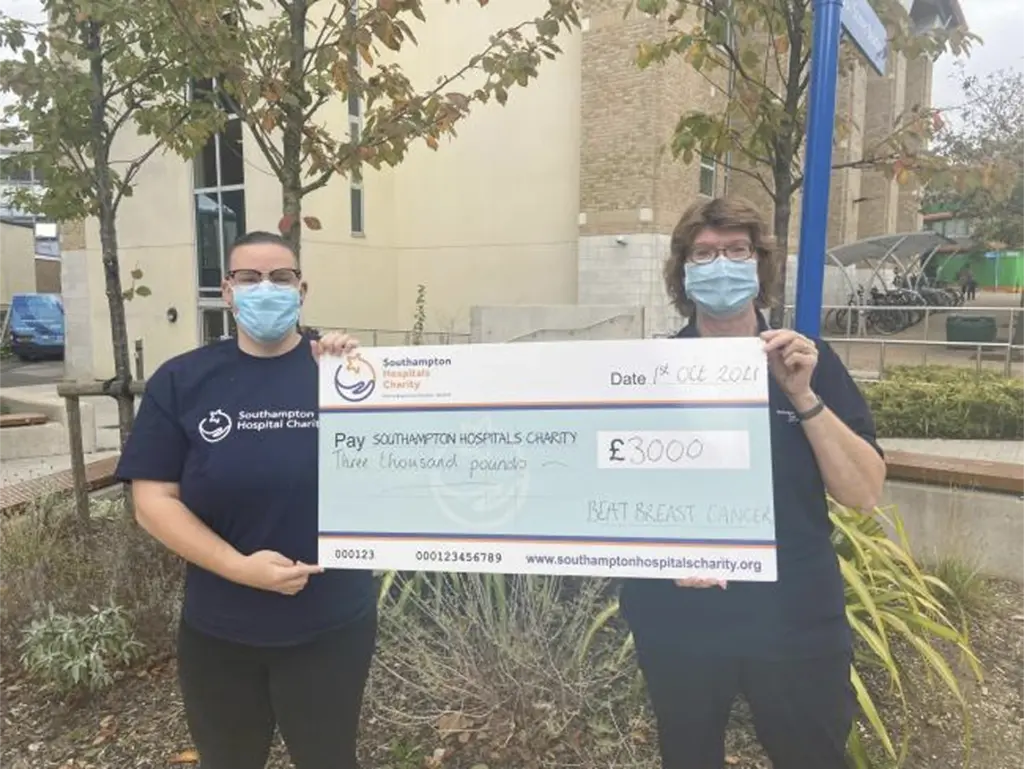
Most charities take a cut of every pound for fundraising, admin or overheads before the rest goes to work. We don’t. Beat Breast Cancer runs a strict 100% donation policy: every penny you give goes directly to funding equipment and research at NHS trusts, with nothing skimmed off for running costs.
That means Gift Aid isn’t just “free money for the charity” in the abstract. It’s free money that reaches the cause in full, the same way your original donation does. So far, gifts through this charity have put over £40,000 into equipment and research across seven NHS trusts, from Guy’s and St Thomas’ to Royal Blackburn Hospital. Gift Aid on those same donations would have added another quarter again, at zero extra cost to any of the donors involved, and it would have arrived at the hospital, not been absorbed somewhere in between.
Who can use Gift Aid
You’re eligible if all of the following are true:
- You’re a UK taxpayer.
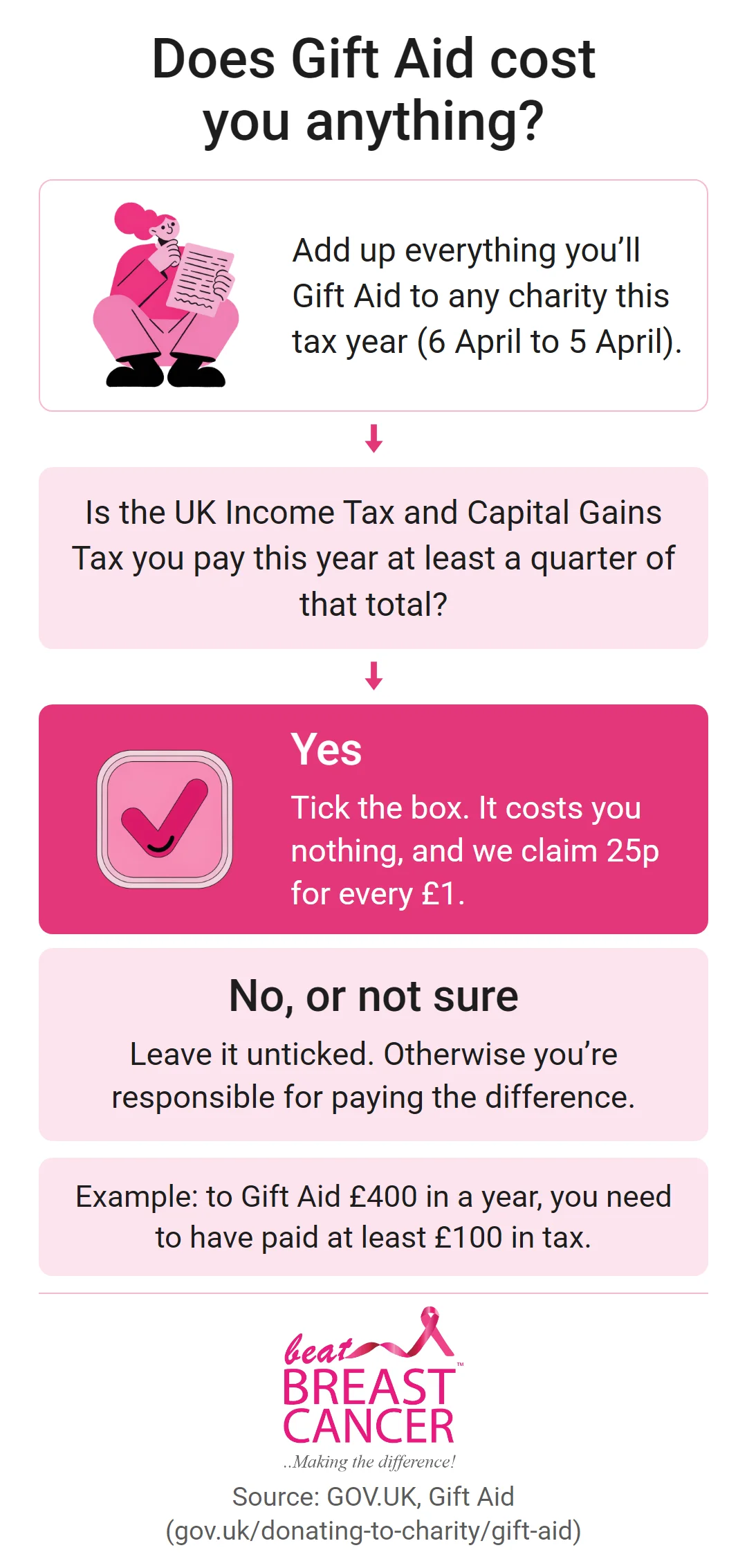
- You’ve paid, or expect to pay, enough Income Tax or Capital Gains Tax this tax year to cover the amount being reclaimed. As a rule of thumb, your total Gift Aided giving across all charities in a tax year shouldn’t come to more than four times what you’ve paid in tax.
- You’re happy to make a Gift Aid declaration, a short statement confirming the above (it takes seconds, not a form you need an accountant for).
You don’t need to be a high earner. If you pay tax on your salary, pension, savings or investments, and you pay enough of it, you almost certainly qualify. If your only income is the state pension, you may not pay enough tax to qualify, so it’s worth checking before you tick the box.
One declaration can cover your current donation, every future donation you make to us, and any donations you’ve already made in the last four years. You only need to do it once.
How to add Gift Aid to your donation
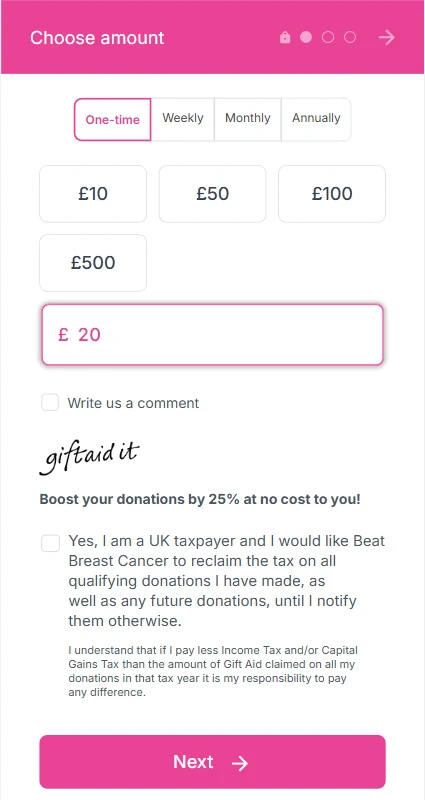
When you donate to Beat Breast Cancer through our donation form, there’s a Gift Aid option as part of the checkout. Tick it, confirm you’re a UK taxpayer, and that’s the whole process. No extra payment, no separate form to post, no follow-up.
If you’ve already donated and didn’t tick the box, get in touch and we can look at backdating it, within the four-year window HMRC allows.
If you’re a higher-rate taxpayer, there’s more for you too
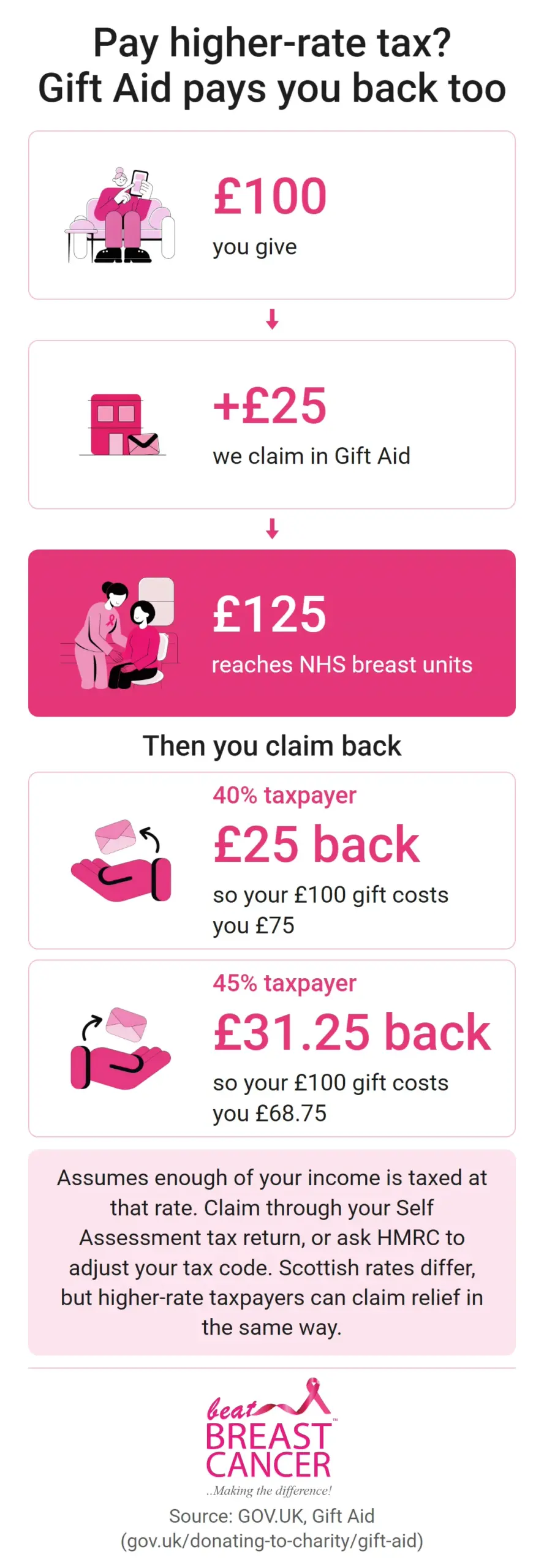
Gift Aid isn’t only good news for the charity. If you pay tax above the basic rate, you can personally claim back the difference between what you pay and the 20% basic rate the charity reclaims.
HMRC’s own example: you donate £100, we claim Gift Aid to make it £125, and if you pay 40% tax, you can claim back £25 yourself through your Self Assessment tax return (or by asking HMRC to adjust your tax code). If you pay the 45% additional rate, that rises to £31.25 on the same £100 gift. Scottish income tax rates differ, but the charity still receives 25p for every £1, and if you pay more than 20% you can claim back the difference yourself, on top of what the charity gets.
Some donors choose to give that reclaimed amount straight back to the charity, effectively letting Gift Aid work twice over on the same act of generosity.
Common questions
Does Gift Aid cost me anything?
Not if you’ve paid enough tax. The extra 25% comes from tax you’ve already paid, not from your bank account, and there’s no fee or hidden charge. The one thing to check is that the Income Tax or Capital Gains Tax you pay in the tax year covers the Gift Aid claimed on all your donations. In practice, your Gift Aided giving shouldn’t come to more than four times the tax you’ve paid. If it does, you’re responsible for paying the difference. Claiming it costs us nothing either, beyond a short admin process on our end.
Is there a limit on how much I can Gift Aid?
There’s no fixed maximum. The only limit is the tax you’ve paid: across all the charities you support, your Gift Aided donations in a tax year shouldn’t be more than four times the Income Tax and Capital Gains Tax you paid that year.
Can I Gift Aid donations to more than one charity?
Yes. You make a separate declaration for each charity you support, but there’s no limit to how many you can be signed up with at once, as long as your total tax paid covers everything being reclaimed across all of them.
What if I stop paying enough tax?
Tell us, and every other charity you’ve made a Gift Aid declaration with, as soon as your circumstances change, and we’ll stop claiming on your donations. If the Gift Aid claimed on everything you gave in a tax year comes to more than the tax you paid, you’re responsible for paying the difference. If you don’t pay UK Income Tax or Capital Gains Tax at all, please leave the Gift Aid box unticked.
Can I backdate Gift Aid on past donations?
Yes, up to four years. If you’ve been giving to us for a while and never ticked the box, one declaration now can cover the donations you’ve already made within that window, as long as you paid enough tax in each of those years.
Do I need to fill anything in every time I donate?
No. One declaration covers this donation, every future one, and the past four years if you choose. You only repeat it if your tax status changes and you need to update us.
Can I add Gift Aid to money collected at work?
Not under your own name. Gift Aid can only be claimed on a person’s own donation, so you can’t add money pooled from colleagues to your own declaration, and payments for raffle tickets or compulsory entry fees for a workplace event don’t qualify at all. Each eligible colleague can Gift Aid their own donation if they make their own declaration and their gift is recorded against it. Our guide to breast cancer fundraising ideas at work explains how to handle this for a workplace event.
Why do some tickets cost more with Gift Aid?
Charity attractions such as museums and heritage sites can only claim Gift Aid on an entry payment if it counts as a donation: you pay at least 10% more than the normal admission price, or your payment gets you in for at least a year. That’s why the Gift Aid price is higher. The extra is what makes the whole payment a donation the charity can claim on, and you can usually choose the standard price instead. Donating to us works differently: ticking the Gift Aid box doesn’t change the amount you give.
Every tick adds up
Gift Aid is one of the few genuinely free ways to increase your impact. No extra spending, no complicated forms, just one tick that turns your donation into more equipment, more research and more support for people affected by breast cancer, in full, because of how we run.
If you want to see the scale of what that funding is working against, our guide to breast cancer statistics in the UK sets out the numbers behind the need.
Planning something for October? Our Breast Cancer Awareness Month guide has the key dates and easy ways to get involved.
Donate to Beat Breast Cancer and tick the Gift Aid box if you’re a UK taxpayer. It takes seconds, and it means 25% more of every pound reaches the cause.
Sources: GOV.UK – Tax relief when you donate to a charity: Gift Aid; HMRC, Charities detailed guidance, chapter 3: Gift Aid. Higher and additional-rate relief figures calculated using HMRC’s standard formula and cross-checked against published guidance.